Real-Time Bidding Explained: How Modern Programmatic Auctions Work Today
Behind every digital ad impression is a rapid decision-making process that happens in milliseconds. This process, known as Real-Time Bidding (RTB), forms the backbone of modern programmatic advertising. While the concept has existed for years, RTB today looks very different from its early iterations- driven by AI, identity intelligence, and privacy-first data strategies.
Understanding how modern programmatic auctions work is essential for advertisers seeking efficiency, transparency, and scale in an increasingly complex media ecosystem.
What Is Real-Time Bidding?
Real-Time Bidding is an automated auction-based process through which digital ad impressions are bought and sold in real time. When a user visits a website or app, an auction is triggered, allowing advertisers to bid for that impression based on audience relevance, campaign objectives, and contextual signals.
All of this occurs in fractions of a second, ensuring that the most relevant ad is served to the user without disrupting the browsing experience.
How Modern Programmatic Auctions Operate
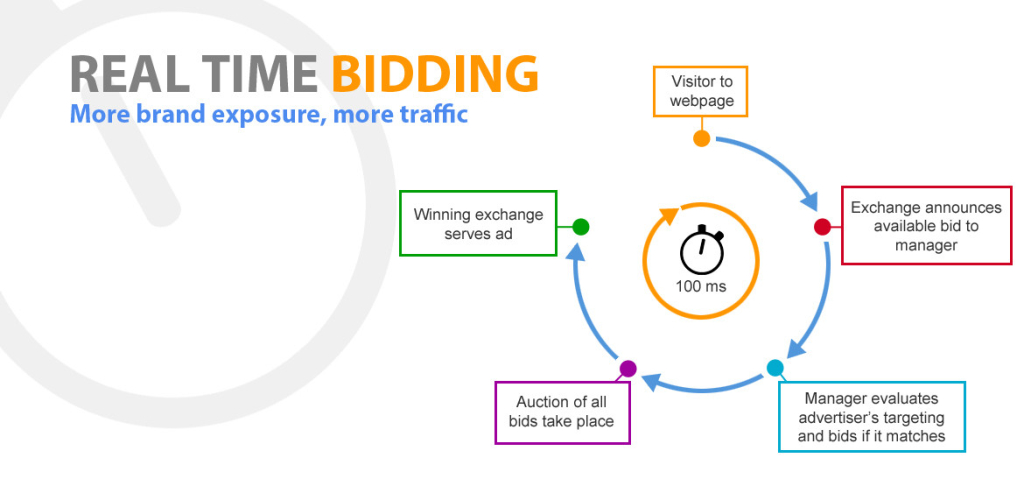
When a user loads a page, available ad inventory is sent to an ad exchange along with anonymized data signals such as device type, location, content context, and audience attributes. Demand-side platforms (DSPs) evaluate this information against advertiser criteria and submit bids accordingly.
The auction is then executed, and the highest-value bid – based on price and relevance – wins the impression. The entire process typically completes within 100 milliseconds.
What differentiates modern RTB from earlier models is the intelligence applied at each stage.
The Role of AI in Real-Time Bidding
AI has transformed RTB from a simple price-based auction into a sophisticated decision engine. Machine learning models analyze historical performance, behavioral patterns, and real-time signals to predict the likelihood of engagement or conversion.
These predictions inform bid values, budget allocation, and frequency decisions dynamically. Instead of static rules, AI enables continuous optimization – ensuring bids reflect current conditions rather than outdated assumptions.
This intelligence allows advertisers to compete efficiently at scale while minimizing wasted spend.
Identity and Relevance in a Privacy-First Environment
As third-party cookies decline, identity resolution has become central to effective RTB. Modern programmatic auctions increasingly rely on first- and zero-party data, unified through identity graphs, to determine relevance without invasive tracking.
By resolving users across devices and channels within consented frameworks, identity-driven RTB maintains accuracy while respecting privacy regulations. This ensures that bidding decisions are based on meaningful signals rather than fragmented or unreliable identifiers.
Transparency and Control in Today’s Auctions
One of the historical criticisms of programmatic advertising has been opacity. Modern RTB frameworks address this by offering greater visibility into bidding logic, inventory quality, and performance metrics.
Advertisers now have more control over where ads appear, how budgets are allocated, and which signals influence bidding decisions. This transparency builds confidence and supports long-term brand safety and performance goals.
Why RTB Still Matters
Despite evolving technologies and regulatory changes, RTB remains foundational to digital advertising. Its ability to balance scale, relevance, and efficiency makes it indispensable in omni-channel strategies.
When powered by AI and identity intelligence, RTB enables advertisers to reach the right audiences at the right moment – without manual intervention or excessive data dependency.
Where This Leaves Advertisers
Real-Time Bidding has evolved into a highly intelligent, privacy-aware system that supports modern advertising at scale. Success in today’s programmatic auctions depends not just on bidding faster, but on bidding smarter – using high-quality data, AI-driven insights, and transparent execution frameworks.
With Cubera’s AI-led AdTech ecosystem, advertisers can navigate real-time auctions with confidence – leveraging identity-driven intelligence, advanced optimization, and full-funnel visibility to deliver consistent, measurable outcomes.